
What is in this guide
- The 7 signals at a glance
- A portfolio you can verify
- Independent reviews
- Awards and credentials
- Client references
- Quote, contract and payments
- Who executes the work
- Timeline, warranty and aftercare
- Bangalore apartment checklist
- Red flags in the first meeting
- Questions to ask before you sign
- Frequently asked questions
Picture this. You’ve shortlisted a designer for your new 3BHK. The 3D renders are gorgeous, the quote looks reasonable, and the first payment request lands in your inbox before you’ve even finished your coffee. Do you pay?
(This is a hypothetical, not a real client story. But if your stomach just tightened a little, good. That instinct is exactly what this article is about.)
Choosing an interior designer in Bangalore is not a taste decision. It’s a trust decision. You’re handing over a large budget, access to your home, and months of your life to someone you met a few weeks ago. Pretty photos don’t tell you whether the work will be finished properly, on time, and without surprise bills.
So here are 7 trust signals to check before you hire, and for each one, how to actually verify it, not just what to look for.
The 7 Trust Signals at a Glance
- A portfolio you can verify
- Reviews from independent sources
- Awards and credentials that mean something
- Client references you can call
- A clear quote, contract and payment schedule
- Clarity on who actually executes the work
- Timeline, warranty and aftercare in writing
1. A Portfolio You Can Verify
Every designer has a portfolio. That’s the easy part. What you want to know is whether the work in it is theirs, whether it’s finished, and whether it looks like something you’d live in.
How to verify
- Ask for a completed project similar to yours in size and budget. A stunning villa tells you little if you’re doing a 2BHK.
- Ask to visit a finished site, or a live one in progress. Finished work shows the look; a live site shows the process.
- Look past the hero shots. Ask for photos of storage, corners, joinery edges and the unglamorous rooms.
- Ask which parts of the project the studio designed and which parts it built or installed.
Red flag: Only polished photos, no site visits, and vague answers about who did what.
It’s why we publish The 1963 House stage by stage, from bare block walls to handover, with 145 site photos, alongside the finished homes on our work page. The final photograph is the last ten percent.
2. Reviews from Independent Sources
Testimonials on a designer’s own website are marketing. They’re not useless, but they’re curated.
How to verify
- Check Google reviews and Houzz, and read the detailed ones, not just the star rating.
- Look for reviews that mention specifics: timelines, communication, how problems were handled.
- Notice how the studio responds to negative reviews. Calm and specific is a better sign than defensive or silent.
- Ask in your apartment community’s group chat. Someone has probably renovated in your building.
Red flag: A wall of five-star reviews with identical wording, or no independent reviews at all for a firm that claims years of experience.
3. Awards and Credentials That Mean Something
Awards can be a useful signal. They can also be a pay-to-play badge. The honest answer is that you can’t tell from the trophy alone, and a paid or sponsored award isn’t automatically fake. Plenty of legitimate industry programmes charge entry fees. What matters is whether the award is credible and what it actually recognises.
How to verify
- Who gives it? Look up the awarding organisation. Is it an established industry body, a recognised publication or a design institution? Does it have a track record beyond this one event?
- What are the criteria? Credible awards publish how entries are judged: design quality, execution, innovation, sustainability. If you can’t find the criteria, that’s a gap.
- Who judged it? Named jurors with real industry standing are a good sign.
- What exactly was recognised? A specific project, or just “Best Designer” with no context? Specific is more useful.
- Is it recognised in the industry? Search the award name. If only the winner’s own website mentions it, treat it as a minor signal, not a deciding one.
Also check credentials: a degree or diploma in design or architecture, and membership of a professional body, if the designer claims one. These are easy to ask for and easy to check.
Our take: Awards are a bonus, not a foundation. A designer with no trophies and five happy, reachable clients is a safer bet than one with a shelf of awards and no references.
4. Client References You Can Call
This is the single most underused step. Almost nobody does it, which is exactly why it works.
Ask the designer for contact details of two or three past clients and actually speak to them. Keep the conversation short and ask these three questions:
- Was the project completed on time? If not, how late was it, and how was the delay communicated?
- Were there any unexpected costs? Did the final bill match the original quote? What caused any difference?
- How was the after-sales support? When something needed fixing after handover, did the team respond, and how quickly?
A confident studio will share references without fuss. If a designer keeps dodging this request, that tells you something.
5. A Clear Quote, Contract and Payment Schedule
Most renovation disputes don’t start with bad design. They start with a vague quote.
What a good quote and contract should include
- Scope of work: exactly what’s being designed, built and installed, room by room.
- Exclusions: what’s not included. Electrical rewiring, civil work, appliances, curtains and decor are common gaps.
- Material specifications: brand, grade and finish for boards, laminates, hardware, paint and fittings. “Premium plywood” isn’t a specification. A named grade is.
- Milestone-based payments: payments tied to completed stages, not to calendar dates or a lump sum upfront.
- Written change orders: any change to scope, material or design should be documented, with its cost and its effect on the timeline, before the work happens.
- Delay and responsibility clauses: what happens if the timeline slips and who is responsible.
How to verify
Get itemised quotes from two or three studios and compare line by line. If one is far cheaper, find out what’s missing before celebrating. Our 3BHK interior design cost guide breaks down realistic Bangalore ranges room by room, so you can see where a quote is light.
Red flag: A large payment demanded before any scope, specification or contract is signed.
General advice, not a fixed rule: there’s no single “correct” advance amount. What matters is that the schedule is written down and linked to milestones. At The Haus Projekt, scope, materials, pricing and the project plan are locked in writing when you confirm your order, before anything goes into production. Ask your designer for the payment schedule at that stage, and what each instalment is tied to.
6. Clarity on Who Actually Executes the Work
Here’s a question most homeowners forget to ask: who actually builds this?
In many projects, the designer draws it up, a separate contractor builds it, a carpenter makes the furniture elsewhere, and someone else installs it. That can work well. But each handoff is a place where things can get lost, delayed or blamed on someone else.
How to verify
- Ask who designs, who manufactures, who installs and who supervises the site.
- Ask whether the furniture and joinery are made in-house or outsourced.
- Ask who you call when something goes wrong, and whether that’s one person or three.
There’s no single right model. What matters is that the answer is clear and someone is accountable end to end.
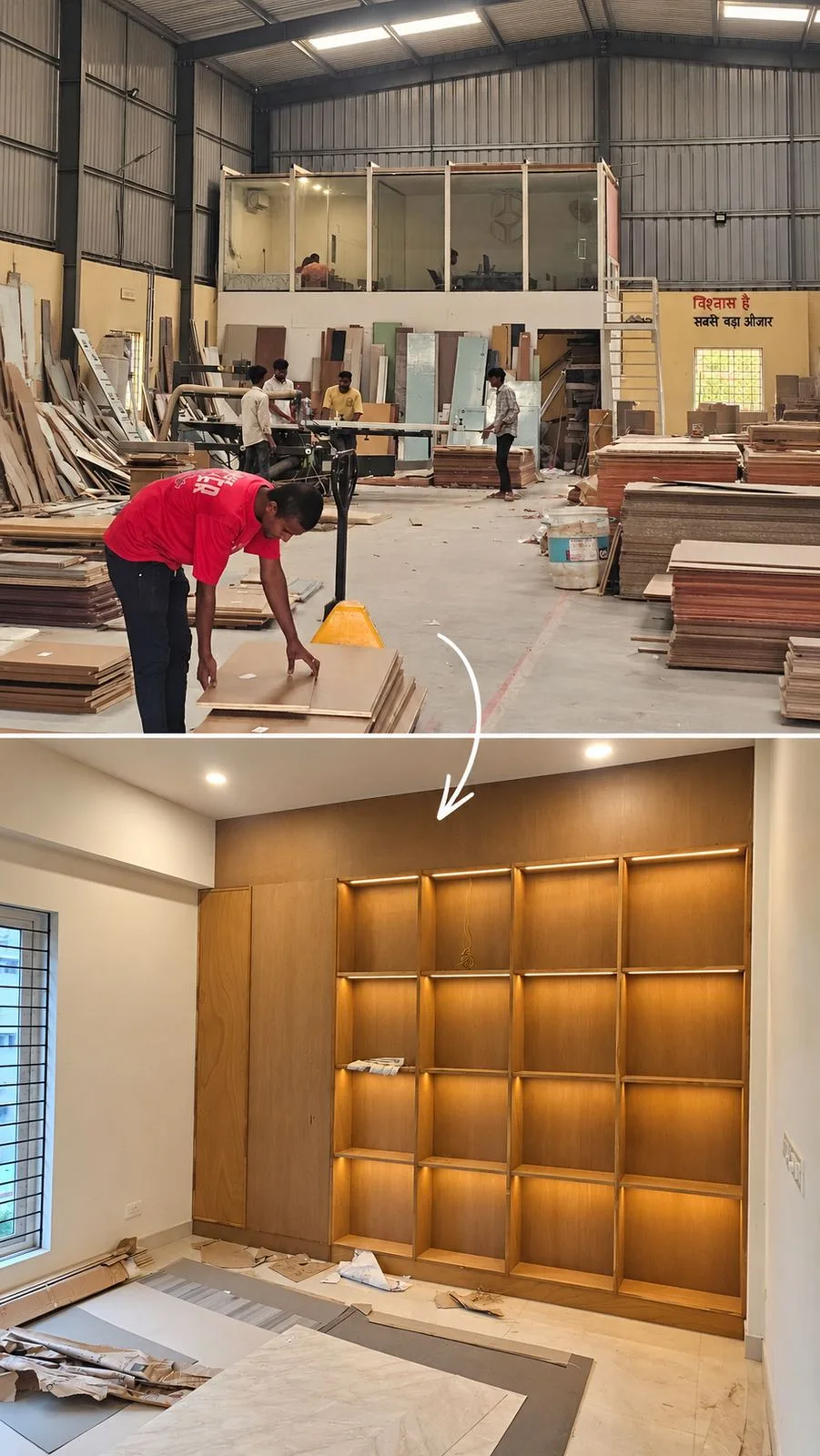
How The Haus Projekt works: The Haus Projekt is a design-and-build studio. It designs interiors, manufactures furniture and interior components in its own factory, and installs them at the client’s home. That means design, manufacturing and installation sit under one roof.
Site coordination (electricals, civil, painters and the timeline) is held together by the same person you spoke to on day one, so your point of contact doesn’t change between the studio, the factory and your home. The factory is a 40,000 sq ft floor in Bangalore with 100+ craftsmen and technicians, a beam saw and CNC router, edge banding, a hot press and a dedicated spray booth. Every unit is dry-assembled and checked against the approved drawing before it’s wrapped, not after it’s in your home. You can take the factory tour by appointment.
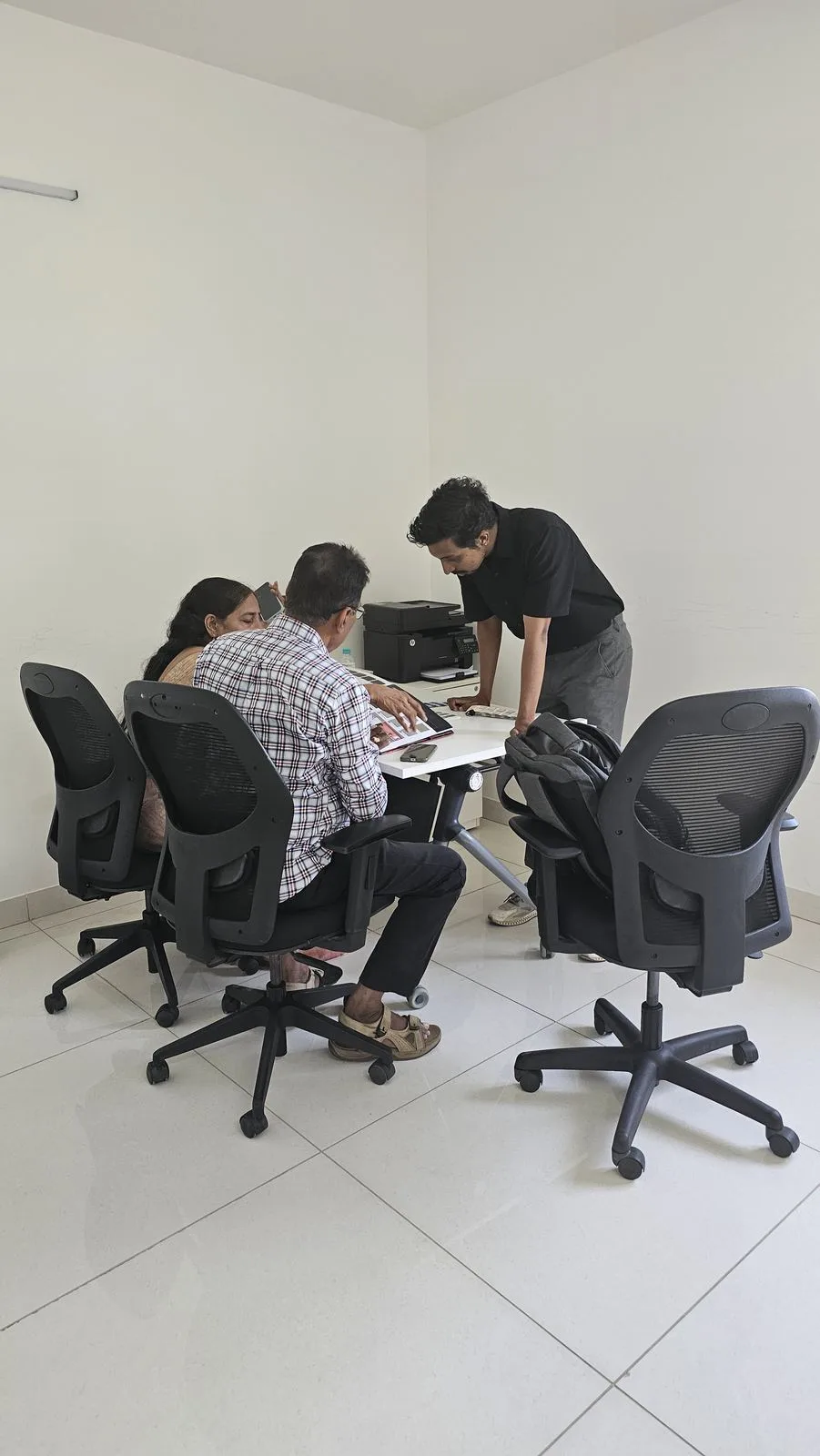
7. Timeline, Warranty and Aftercare in Writing
Ask for a timeline in writing, and ask what it depends on: approvals, material delivery, your own decisions. A realistic timeline explains its assumptions. An impossibly fast one usually hasn’t thought about them.
Then ask about aftercare:
- What does the warranty cover, and for how long?
- How do you report a defect, and who responds?
- Are repairs handled by the same team that built the work?
Get the answers in the contract, not on a call.
Typical timelines vary a lot with scope and size, so be wary of anyone quoting a number before seeing your home. As a rough guide, a 2BHK in Bangalore typically takes about 6 to 10 weeks of execution once the design is frozen, and a turnkey 3BHK about 8 to 16 weeks, depending on approvals, materials and scope. We share the project plan for your home when you confirm your order, and because our factory is in-house, we schedule production ourselves instead of waiting in an outside unit’s queue.
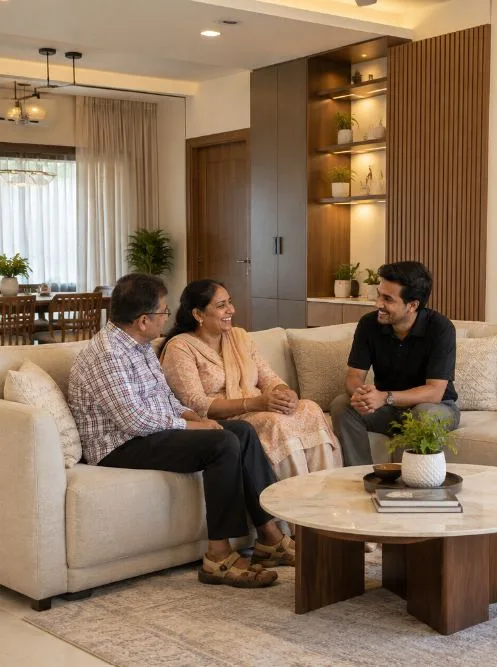
On aftercare: our work carries a lifetime guarantee and a 30-year warranty. Ask your designer for the written terms, including what is covered and what is not, before you confirm your order. Because the same team designs, makes and installs the work, a fix after handover comes back to the people who built it.

Bangalore-Specific Checklist: Ask Before the Work Starts
Apartment living in Bangalore adds its own layer of rules. Rules differ from society to society, so confirm the details with your own association, then check that your designer has handled this before.
- Society permissions: Does your apartment association need an approval or NOC before renovation starts? What documents does it ask for?
- Lift booking: Is there a service lift, and does it need to be booked? Who handles the booking on your project?
- Permitted working hours: What days and hours is noisy work allowed? Does your timeline account for them?
- Material entry: Are there rules for bringing in materials, such as gate passes, vehicle access or delivery slots?
- Debris removal: Who removes debris, how often, and where does it go? Is this included in the quote?
- Common area protection: Who protects the lobby, lifts and corridors from damage, and who pays if something is damaged?
A designer who has worked in apartment communities will answer these without hesitation. If they look blank, that’s useful information too. (For what it’s worth, we handle society permissions, working hours and material access rules as part of the project, in gated communities across the city.)
Red Flags You Can Spot in the First Meeting
- Pressure to pay or sign quickly, with a “limited-time” discount
- No written scope, specifications or contract
- Reluctance to share references or arrange a site visit
- A quote that’s much lower than others and can’t be explained line by line
- Vague answers about who builds and installs the work
- Promises of a fixed timeline before they’ve seen your space
- Awards or reviews they can’t point you to, or that you can’t find anywhere else
Questions to Ask Before You Sign
Take this list to every meeting:
- Can I see a completed project similar to mine, and speak to that client?
- Who designs, manufactures, installs and supervises my project?
- What exactly is included in the quote, and what isn’t?
- Which materials, brands and grades are specified?
- How is payment structured, and what is each payment tied to?
- How are changes to scope or design documented and priced?
- What’s the timeline, and what could delay it?
- What does the warranty cover, and how do I report a problem?
- Have you handled society permissions, lift booking and debris removal in apartments like mine?
- Who is my single point of contact from start to handover?
Frequently Asked Questions
How much advance should I pay an interior designer in Bangalore?
There’s no universal figure, and it varies by firm and project. What matters is that payments are milestone-based and written into the contract, with each instalment tied to a defined stage of work. Be cautious of large payments before scope and specifications are agreed in writing.
What’s the difference between an interior designer and a design-and-build firm?
An interior designer typically handles the design and may coordinate separate contractors to execute it. A design-and-build firm handles design and execution together, which can mean fewer handoffs and clearer accountability. Neither is automatically better; ask who is responsible for what.
Can I trust online reviews of interior designers?
Online reviews are useful when you read them critically. Look for detailed, specific feedback across independent platforms such as Google and Houzz, not just testimonials on the studio’s own site. Then confirm with a reference call.
How long does a 3BHK interior take in Bangalore?
It depends on scope, materials, approvals and decision speed, so there’s no honest one-size answer. Ask for a written timeline based on your actual home, with its assumptions listed. As a rough guide, a turnkey 3BHK in Bangalore typically takes about 8 to 16 weeks of execution once the design is frozen. We share the project plan for your home when you confirm your order.
Are design awards important when choosing a designer?
They can add credibility if the awarding body, criteria and jury are credible and the award recognises a specific project. But they matter less than verified past work, client references and a clear contract.
Final Thoughts
The best interior designer for you is the one whose work you can verify, whose clients will talk to you, and whose contract says what they promise. Check the portfolio, call the references, read the fine print, and don’t pay for anything you can’t see in writing.
If you’d like to see how a design-and-build process works in practice, take a look at our work and our process, or get in touch with the team.
This article is general guidance for homeowners in Bangalore, current as of November 2026. Society rules, contract terms and timelines vary; confirm the specifics for your own home and project in writing.